Welcome to our second newsletter of 2026. For those who were not fortunate enough to be able to stay south this winter, we hope that you have all survived this very unusual winter weather.
2026 Rules
Our thanks go out to those who submitted suggestions for our 2026 Rules. Each submission was reviewed by the board. At this time, it was decided to minimize any changes. The only change will be to the wording for having the shooter prepare their firearm to shoot the stage. To be consistent with other action shooting sports the command from the RO will be “Load and make ready.” All other changes for 2026 are just clarifications and amplifications of our current rules.
Range Officer Certification
The range officer certification process is now listed on our website. Board member Tully Mars is the contact person for this program and can be reached at rangeofficer@historic3gun.com.
Match Director’s Guide
Our first Match Director’s Guide will be available in May. It will contain lots of information for members who are running their own match. While it will contain information and guidance for larger matches, it also applies to regular monthly matches as well. It will also include information like the First Aid article later in this newsletter, that all Match Directors should be aware of.
Cowtown Cowboy Shooters Association (CCSA)
As you are probably aware, CCSA has been running both monthly and annual shoots using H3G rules since the inception of H3G. Unfortunately, because of a new proposed new contract agreement, Barbwire has decided to retire after all of these years supporting action shooting. We want to wish her and Zona all the best. They are maintaining H3G membership. Thank you both for your support. See the message at: http://ccsa-az.com
Cleaning and Lubrication of the 1911 for Competition
Watching the videos on YouTube about the cleaning and maintenance of the 1911, I see these gentlemen taking apart the 1911 pistol. They begin to clean it, but the gun is basically not dirty; just a couple of wipes with a rag and the gun is clean again. Some of these cleaning sessions are endorsing specialty gun cleaning products to make the gun cleaner, slicker, better than ever thought possible.
I am not knocking any of the promoted products but there are lots of ways to clean and lubricate firearms. Shooting 100 rounds through a pistol and then cleaning is not really a great test of any product. These companies should seek out Historic 3-Gun competitors and other types of high round count shooters that routinely put many hundreds of rounds through before cleaning.
For a lot of us, knowledge has usually been gained through the school of hard knocks. Years ago, I remember dirty bullets, lots of crud buildup and the gun running slow after about 150-200 rounds. The pistol would have to be serviced at that time to be reliable. Through the years things have improved drastically. Hi-tek coated bullets stopped the lead build up. Swapping to WST powder cut down on the crud. Moving from rem oil to Lucas blue oil improved keeping the oil where it was needed.
Here is what I do for routine cleaning. First thing I do is don a pair of blue latex gloves from Harbor Freight. Then, very important, is to make sure that all firearms are unloaded! There should be no ammunition on your workstation at this time. This way there is no explaining to the significant other why there’s a bullet hole through the refrigerator.
Field strip the pistol. Lay all the parts out on the cleaning mat.
Did you take the extractor out and firing pin? They need to be cleaned about every second or third cleaning cycle. Even if there’s been a bunch of factory rounds fired, there will still be a buildup of crud. Instead of starting with your favored cleaning product try the following recommendation.
Take a microfiber towel and wipe as much crud as you can off of all parts including the frame, rails, throat, etc. Use a small screwdriver along with a microfiber towel for the rails etc. Run the wood Q-Tips through the extractor hole and into the firing pin hole.
All the easy crud is now gone. What’s left is attached to the metal. Hoppes type solvents are good stuff for this job when used with the stiff nylon brush. Looking down the barrel, it might just need a few patches, or it may be time to bust out the bore cleaning brushes along with elbow grease. Pay special attention to the chamber. Make sure any build up is dealt with. Make sure the slide lock is spotless. I use non chlorinated brake cleaner sometimes to finish getting everything clean. Care must be taken not to get brake cleaner on the wood grips or anything rubber. You will not be happy, trust me.
Now behold the beauty of a marvelously clean set of parts. Yes parts, because now’s the time to lubricate the pistol before assembly. I know everyone has their favorite special oil and that’s another story. I do not subscribe to using grease for slides for these modern tight built 1911’s. I have tried grease and could feel it slow down the pistol.
Then there’s the “dry” crowd that thinks what they think. In my opinion, what’s needed is a light coat of oil on everything and a little heavier on the rails. Using the needle applicator on the Lucas blue bottle run a line down each rail in the slide, a few drops where the barrel locks are, along with the area in front of the locks. The barrel should have a few drops at its locking area along with a few drops toward the muzzle and a couple of drops on the link pin. Assemble the upper. Several drops of oil on the frame rails, top and sides.
Assemble and you will have a clean and well-oiled (not over oiled!) 1911 pistol laying on the table. One time I was talking with Evil Roy about favorite gun oils and he said, “any oil is better than no oil” and in the case of 1911s, too much oil is better than not enough oil.
Alternatives to this, like ultra sonic cleaners, transmission fluid etc. all are valid, but the above suggestions are what works for me. You do clean your magazines once in a blue moon, don’t you? Look specifically at the inside of the feed lips.
A consideration for a quick cleaning job is to squirt brake cleaner inside the firearm’s body without disassembling, and then lightly lube with a spray lubricant. If more dirt is present, then the firearm might need to be disassembled, and a brush used to completely clean the gun.
I’m Dusty Boddams and that’s the Boddam line.
First Aid at Historic 3-Gun Matches (or anywhere else)
First off, we are not talking about Johnny getting a splinter. We are talking about an event that could make Johnny’s mortal coil unwind. This could be several things but generally boils down to blood loss and heart attacks.
Is your club prepared? Do you think that a roll of duct tape and a leather belt have you covered? Is anyone in your club really prepared to administer first aid should the need arise?
For years, few people thought much about this subject. Nowadays, with more awareness and training along with much improved IFAKs (individual first aid kits) being a reasonable price and readily available, a little preparation now could pay great dividends in the future.
If something bad happens, who do you call? What is the club’s street address? What is the ETA for emergency responders? Does the club have a defibrillator? Does it work? Does your club have any first responders?
Have you talked about this issue during a club meeting to find out who knows what? Have you considered some of the following:
- If you are way out in the country, is it best to transport toward emergency services in a private vehicle?
- Do you have GPS coordinates at your location where your matches are held in case care flight needs to transport?
- Do you have your full range address at all ranges so that this can be clearly communicated to emergency responders by anyone on the range.
I’m not a first aid expert, but we have several members that are well versed in emergency first aid at our club. These members have received professional training and have applied these learned skills to buy time and prevent death.
Being Captain Obvious here, a person can have access to lots of equipment but without knowledge it is of limited help. A person with knowledge can do remarkable things with just a little bit of equipment. Shooters should carry at minimum, a good tourniquet and an Israeli bandage (a combat proven first aid device for staunching blood flow from traumatic hemorrhage wounds). Even better would be an IFAK.
All competitors need to take a basic first aid course and/or one of those “stop the bleed” courses, to learn how to apply a tourniquet and use an Israeli bandage in addition to many other helpful things.
We are blessed to have several members of our club know first aid through military and law enforcement. One member, Timmy Ringo, has great practical knowledge and we feel that he is best to answer a few basic questions about this topic.
First, about tourniquets, the number one mistake folks make is that they buy the tourniquet and leave it in the plastic wrapper with the rubber bands attached just as it was purchased. What he says needs to be done is to preload the tourniquet to have it ready to go in event of an emergency. The idea is to take the tourniquet out of the wrapper and get it already to use, so all you have to do is slide it over the arm or leg, whatever you need to do with it and then tighten it as required.
Second, about the Israeli bandage, he states that these are vital for many situations and bleeding problems. Tim said the best way to ready oneself for an emergency is to seek out a good instructor that offers hands on experience in the use of tourniquets, Israeli bandages, splints etc. and become familiar with these tools, arming yourself with the knowledge for proper use.
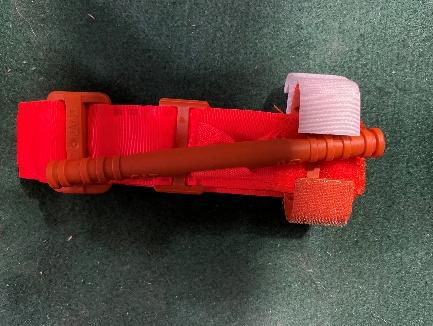
Tourniquet
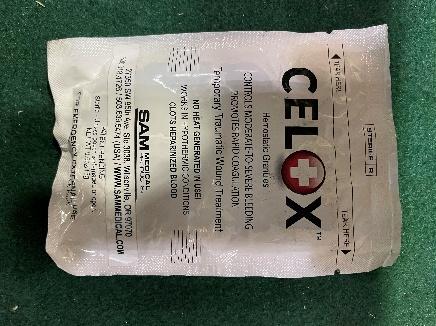
Blood Clotting Material
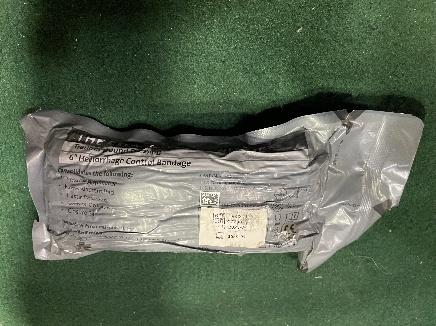
Trauma Wound Dressing
I’m Dusty Boddams and that’s the Boddam line!